
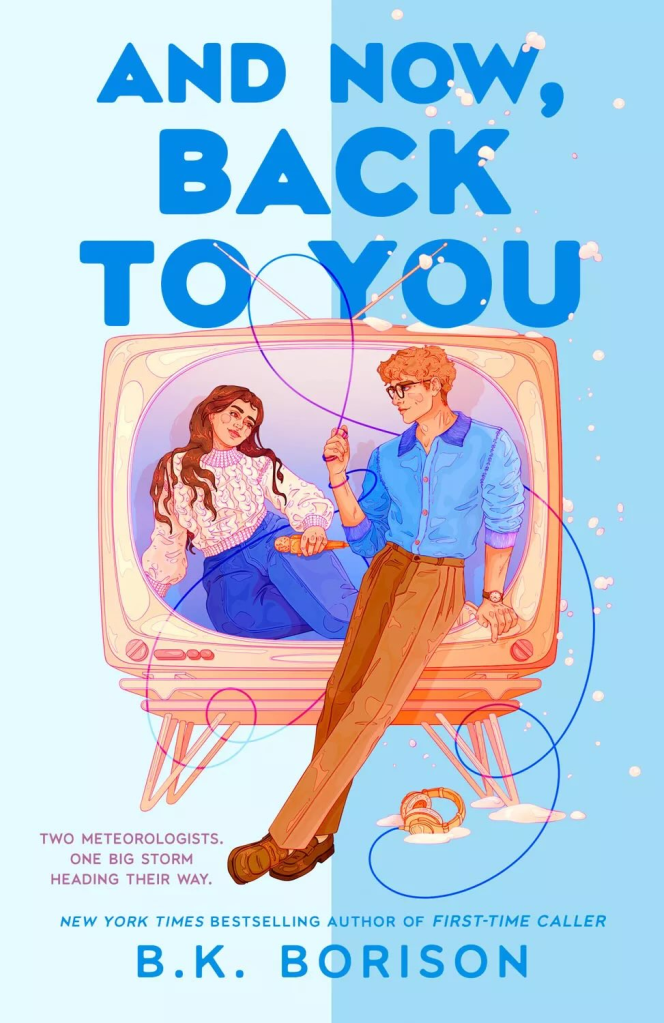
When Harry Met Sally is my favourite movie, so when I saw that B.K. Borison (by all counts a booktok darling) was penning a WHMS inspired romcom on NetGalley I had to request it. Me, a woman who loves a good romance, and this, a book inspired by one of her favourites, what could go wrong?! Unfortunately, I think the comparison to such a well-loved film might be the kiss of death for what is otherwise a relatively enjoyable romance. This is much the same issue I had with Ava Reid’s Lady Macbeth – drawing comparison, or in the case of LM claiming to be a fully fledged retelling, leaves the reader with predetermined expectations, which the work cannot meet.
I should clarify that And Now, Back to You is not a bad book. Borison has a real talent for comedy, the humour in this novel is realised and startling, if slightly unrealistic. It’s hard to write physical comedy, and lines which really land, but Borison manages to do both, and with great skill. Equally, she has a great skill with locations, and snapshot moments, grounding the story in place and atmosphere with repeated success. She is a goodwriter, and this is a propulsive and mechanically sound novel.
In her acknowledgements Borison states that Delilah is not a manic pixie dream girl, she’s wild and fun and sunshine-y, but she isn’t unserious or lacking depth. To an extent this is true. Delilah has real things happening in her life, and moments of legitimate emotional depth. She is also, it has to be said, a sugar-fuelled whirlwind of chaos, with a tendency towards slapstick-esque accidents. Borison presents us simultaneously with a woman who wishes to be taken seriously, and a character whose unending bad luck, cavity-inducing eating-habits, and happy-go-lucky demeanour all scream “manic pixie romantic comedy leading dream girl”. Delilah is a contradiction, and I struggled to relate to her extremes of personality. I also struggled with the choice to make her curvier than the average romance novel protagonist, and show her shovelling sweets and cakes into her mouth all the time. I am a bigger person, and I know lots of women with similar body types to mine, and none of us subsist on sweets and coffee. This seemed a slightly unfair representation, in a market that so rarely represents women with bigger bodies, it landed like a punchline.
By contrast, I found Jackson very relatable, and relatively likable, but I felt there was a similar contradiction at his core. On the one hand he wants to loosen up, on the other he has pressures, responsibilities, and a hefty dose of trauma, all of which ground him as the more realistic and sensible grump to Delilah’s sunshine. Despite finding Jackson more relatable, I couldn’t parse his motivations. They start on the wrong foot, and never seem to address those issues in a real way. Jackson’s gripes with Delilah are relatively legitimate, perhaps a little dramatic, but based in repeated uncomfortable interactions, whilst his attraction to her seems to be instant, pre-existing, and a surprise. I wanted to be swept up in their romance, but I just couldn’t see it. The chemistry was lacking, and the cycle of miscommunication-communication-backing out was both too protracted, and not nearly dramatic enough to warrant such lengthy discussion.
Borison is a skilled weaver and tugger of heart-strings, I don’t want to sell her short. There is an emotional core, present mostly in the sub-plots and wider inter-personal relationships, which is endearing and raw, but which subsequently leaves the central romance noticeably lacking. Jackson’s relationships with his sisters and mother, and Delilah’s struggles at work, her friendships and her family relationships are all very well written, and they pack a punch. This made the absence of emotional connectedness between the leads more noticeable. I could read what Borison was saying but I didn’t necessarily feel their connection. I think this was made worse by the yo-yoing between precise mechanical details (e.g., exactly where arms and legs are) and implied movement (e.g., suddenly doing something which would be twister-esque unless there’d been some shifting around) in intimate scenes.
This isn’t a bad book, but it under-delivers, especially because comparison is drawn to such a successful and well-loved movie. 3 stars.
 Let's Talk Books
Leave a comment