
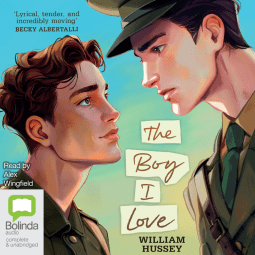
The last William Hussey book I read was a hopeful coming of age story, struck through with humour. In contrast, The Boy I Love is a moving, emotional, well-penned novel filled with swathes of stirring romance, and very occasional moments of levity.
Like all war narratives, this is, and must be, deeply sad. Similarly, this is a novel which is deeply frustrating, to see the homophobia so many of us are aware of play out in the most unfair and heart breaking of ways. Set in the month or so leading up to the Battle of the Somme, The Boy I Love follows Second Lieutenant Stephen Racksall as he meets, and begins to fall in love with, Private Danny McCormick, a fellow soldier not yet scarred by the reality of war. Filled with history, Hussey’s novel is at once a love story, and a love letter to the men we lost in one of the most brutal wars of the 20th century.
A lot of the negative reviews I have encountered about this book question the message of this novel, and the implied alternative reality at the crossroads of the plot, after all, is Hussey not positing that a kinder more equitable, more accepting society might have listened to our leads? That, if homophobia hadn’t existed, the war might have been shorter, or at least less bloody? To those reviewers, and to anyone who has encountered the same ideas, I would say this: wouldn’t it? If our society was not homophobic, racist, misogynistic, and unfair, would not all the tragedies of our history have been different? Wouldn’t we have flown earlier, and sailed earlier, and cured illness earlier, if we had allowed all of the people who we, the white, straight, educated majority, looked down upon to help? I think we would. Here’s a fact few people know, when doctors (all male & predominantly white) started discussing the possibility of washing their hands between patients it wasn’t because one of them had a dream, or was struck by sudden inspiration, it was because they noticed that the patients of midwives, who did wash their hands between patients, had a better survival rate. The knowledge or marginalised people, in this example women, has always been discounted, and in embracing it we, as a society, have been able to improve. I think Hussey’s message is powerful, I also think it’s reasonable, and fair, and quite possibly true.
This is excellently written, if clearly for a YA audience, and perhaps suffering a little from insta-love. It is also moving, and historically accurate. Hussey has put in the hours, the time in archives, libraries, and museums, to craft a novel which has as much story as it does history, and I hope that this finds its audience. 3.5 stars.
 Let's Talk Books
Leave a comment